Are the end times upon us? Reading the reports from the media, you may be led to believe so: unscrupulous sources depict a dangerous super-plague originating from Wuhan, promising annihilation on a global scale. The true story of this new coronavirus, however, is more complex and (unsurprisingly) less sensational: it is a story of epidemics past and present, of political lessons learned, and of public health lessons neglected.
To simply call the novel virus present in Wuhan “coronavirus” is an oversimplification. The term coronavirus refers, in fact, to an entire family of viruses, most of which cause little more than “the sniffles” and a sore throat in healthy people. Most coronaviruses only spread to the lower respiratory tract in a few individuals (due to the viruses’ preference for lower temperatures). Given that coronaviruses cause 2-10% of common colds(1), many of us will already have experienced the effects of one!
The name “coronavirus” comes from the appearance of the viruses: club-like glycoproteins protrude from their lipid bilayer, giving them the appearance of having a “crown” (a corona in Latin). It is these E2 protein “spikes” that have a role in binding to human cells. The coronavirus family has a single-stranded positive-sense RNA genome that, upon infecting a cell, is first translated by host cell ribosomes to form a viral RNA polymerase and other proteins. Using this polymerase, negative-sense RNA templates are produced: from these templates, new viral genomes are replicated and mRNAs coding for individual viral proteins can be created. The host cell assembles the virus and a new virion is born. Coronavirus infection is cytolytic, meaning it causes cell destruction, and is spread from person to person by fluid droplets and aerosols (after all, coughs and sneezes spread diseases!)(2).
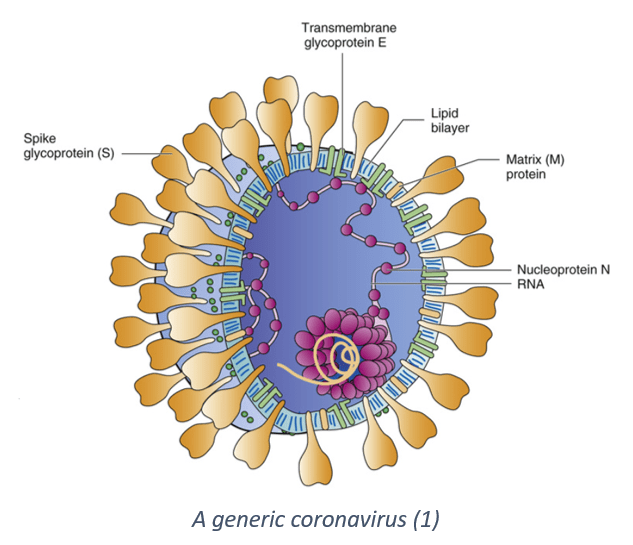
Infection by a common coronavirus is a minor event for most people: their immune systems quickly fend off this cellular invader, with the host only experiencing some upper respiratory tract symptoms such as sneezing and a sore throat. Clearly, then, this new coronavirus (named 2019-nCoV,meaning “2019 Novel Coronavirus”) is something a little outside of the ordinary; it causes pneumonia, an inflammation of the lung tissues, and is associated with a rising number of deaths. So why is this new virus more dangerous than its relatives? The answer lies in its origin: this novel virus is zoonotic(3), meaning that it has crossed from another species to humans. As a result, the virus has different properties to those normally found in our populations and so causes greater illness and mortality in humans. It seems likely that 2019-nCoV is most dangerous to vulnerable individuals such as those with respiratory disease and the elderly.
So, we have discussed the general nature of coronaviruses and seen why 2019-nCoV is unusually dangerous. Next, we will consider exactly what and where the origin of the virus may have been, and discover why it may not be so unusual after all…
Author: Ben Dimbleby
References:
(1) Murray PR, Rosenthal KS, Pfaller MA. Medical Microbiology E-Book. Philadelphia: Elsevier; 2015. Available at: https://clinicalkeymeded.elsevier.com/#/books/9780323359528/
(2) Andersson MI, Korsman SNJ, Zyl GV, Preiser W, Nutt L. Virology: an illustrated colour text. 2012; Available at: https://clinicalkeymeded.elsevier.com/#/books/9781455742134/
(3) Ji W, Wang W, Zhao X, Zai J, Li X. Homologous recombination within the spike glycoprotein of the newly identified coronavirus may boost cross-species transmission from snake to human. Journal of medical virology 2020 Jan 22,.

